Shorts pay far less per view than long videos. In figures measured on 274 real channels, a thousand Shorts views paid between $0.02 and $1.48, which AIR Media-Tech puts at roughly 3% to 14% of what the same niche earns on long videos. Music was the one exception. Shorts are paid from a shared monthly pool, not per video.
How the pool works
YouTube’s Shorts monetization page describes four steps. Only ads that play between videos in the Shorts Feed are included, and they are kept apart from the ads on long videos. (YouTube Help, YouTube Shorts monetization policies)
- Pool the revenue. Each month, the money from ads running between Shorts is added together. It is used both to pay creators and to cover the cost of music licensing.
- Calculate the Creator Pool. A Short with no music sends all of its revenue to the pool. A Short with music splits the revenue between the pool and music partners by the number of tracks: with one track, half goes to the pool, and with two tracks, a third.
- Share out the pool. The pool is divided among monetizing creators by their share of all engaged Shorts views in each country. A creator with 5% of the eligible engaged views gets 5% of the pool.
- Apply the revenue share. Creators keep 45% of what is allocated to them, whether or not they used music.
Two details: the split is made in each country, and music costs come out of the pool before it is shared, not out of the creator’s 45%.
The page adds conditions that decide which views count. Shorts earnings start on the date you accept the Shorts Monetization Module, and views before that date are not eligible. Views of unoriginal Shorts, such as reuploads and compilations with nothing added, views from bots, and views of Shorts that break the advertiser-friendly guidelines do not count. Shorts over one minute that contain claimed content are blocked from monetization.
YouTube’s own example, worked through
YouTube’s page runs a hypothetical, with made-up figures, to show the steps. The same sum is below.
| Step | Amount |
|---|---|
| Engaged Shorts views in Country A, all by monetizing creators | 100 million |
| Ad revenue between Shorts in Country A | $100,000 |
| Share of Shorts that use one music track | 20% |
| Music licensing cost taken out (half of 20% of $100,000) | $10,000 |
| Creator Pool | $90,000 |
| Your Short’s engaged views | 1 million, or 1% of the total |
| Your allocation, 1% of the pool | $900 |
| Your earnings at the 45% share | $405 |
On YouTube’s numbers, one million engaged views earned $405 in that country, which works out to $0.405 per 1,000 engaged views. That is an illustration of the mechanism, not a rate you can expect. The real rate depends on what advertisers pay in each country and how crowded the pool is.
What real channels were paid
AIR Media-Tech published Shorts RPM from the YouTube Analytics API for 274 channels it works with, across 3,044 channel-months, as full-year medians. It does not say which months the data covers. Its channel sizes are by monthly views: small is 10,000 to 100,000, medium is 100,000 to 10 million, and large is 10 million to 50 million. The article’s text gives these topic figures per 1,000 views:
| Topic | Shorts RPM (median) | Channel size |
|---|---|---|
| Music | $1.48 | Small |
| Music | $0.97 | Medium |
| Lifestyle | $0.16 to $0.20 | Medium |
| Crafting and handmade | $0.11 | Not stated |
| Kids and teens | $0.02 to $0.05 | Large |
(AIR Media-Tech, September 17, 2026) The overall range across the whole data set was $0.02 to $1.48. The article gives no Shorts figure in its text for several other topics, so this post does not guess them.
At those rates, one million Shorts views would be worth about $970 for a medium Music channel and $1,480 for a small one, $160 to $200 for a medium Lifestyle channel, $110 for a Crafting channel, and $20 to $50 for a large Kids channel. These are medians for different channel sizes, not the low and high of one group. The gap to long videos is wide: in AIR Media-Tech’s separate long-video study, medians sit between $0.33 and $10.22 depending on topic, which another post sets out in full.
Music stands out because of Content ID. AIR Media-Tech’s explanation is that when a Short uses copyrighted music, the rights holder is paid through Content ID, and music channels that own their rights collect that on top of ordinary ad revenue. A gaming, cooking or education channel has no such second stream. AIR Media-Tech adds that YouTube’s announcement does not spell out how the 2027 change treats Content ID payouts, so Music channels should watch their own revenue after February 1.
Since August 24, 2026 the public count under a Short starts at the first frame. YouTube says Shorts are paid on engaged views, so these RPMs are per engaged view. (YouTube Official Blog, August 19, 2026) Where the public count and the engaged count differ for your Shorts, use the engaged count.
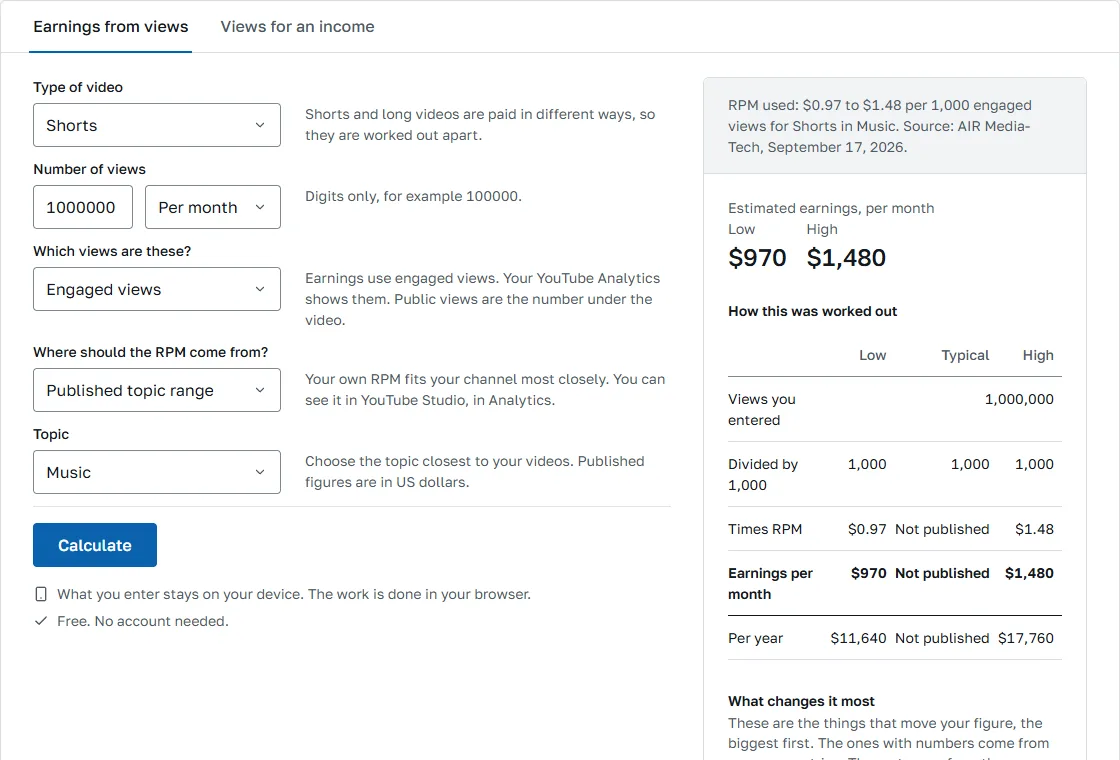
The YouTube money calculator uses only the figures above for Shorts. When AIR Media-Tech’s text gives no number for your topic, it says so and asks for your own RPM, or offers the overall range of $0.02 to $1.48. For Music, its “low” and “high” are the two published medians.
The rule that starts on February 1, 2027
From February 1, 2027, a channel needs at least 10 million qualified Shorts views in the last 90 days to share in Shorts ad revenue and the Shorts part of YouTube Premium revenue. The views are measured over the 90 days that end on the 15th of the month before the month being paid. Channels below the line stay in the Partner Program and keep earning on long videos. Their Shorts revenue share resumes when they cross 10 million again. (YouTube Help, Shorts monetization policies; YouTube Blog, August 10, 2026)
Ten million views in 90 days averages out at about 3.3 million a month. A channel with one million Shorts views a month would be below the line, and under the rule its Shorts ads would stop paying until it grew.
Three different Shorts numbers are in play, which is easy to mix up:
| What it is for | Shorts views needed | When |
|---|---|---|
| Joining the Partner Program, with 1,000 subscribers | 10 million qualified views in 90 days | Today |
| Joining the Partner Program, as a new applicant | 20 million qualified views in 90 days | From February 1, 2027 |
| Sharing in Shorts ad revenue, for every channel | 10 million qualified views in 90 days | From February 1, 2027 |
The Partner Program requirements are covered in their own post.
YouTube also says it will introduce new ways to earn for channels below the line, such as bonuses for YouTube Shopping, incentives for brand deals and boosts for starting and growing trends, and that it will share details soon. As of November 29, 2026, the pages checked for this post gave no figures for them, so nothing here includes them. And from the same date, Shorts ads aimed at small groups of five or fewer channels become eligible for direct revenue, with creators keeping 45% of the net revenue from the specific ad, in addition to the pool.
Shorts as a growth tool
AIR Media-Tech found that Shorts made up under 2% of total revenue for most channels in its data while often using a large share of the production effort. Its reading is that Shorts widen the number of people who find a channel and that long videos are where that audience pays. Whether that holds for your channel depends on your own numbers.
If your analytics split Shorts from long videos, take the Shorts RPM from there and use it in a calculator with your lowest and highest month. If not, use the published ranges above as a rough guide and treat the result as an estimate.
Sources
All pages were read on November 29, 2026.
- YouTube Help, YouTube Shorts monetization policies
- YouTube Blog, new opportunities to earn and changes to the Partner Program, August 10, 2026
- YouTube Official Blog, what are engaged views, August 19, 2026
- AIR Media-Tech, what is YouTube Shorts RPM in your niche in 2026, September 17, 2026
- AIR Media-Tech, which YouTube niche makes the most money in 2026, July 1, 2026
This site is not connected with YouTube, Google or AIR Media-Tech. The post is for information and is not financial advice.