CPM is what advertisers pay. RPM is what you receive. If you want to estimate your own income, use RPM, because it already has YouTube’s share taken out and counts every view, including those that carried no ad. CPM multiplied by your views will give you a wrong number, sometimes too high and sometimes too low.
The three numbers
YouTube’s help page names three figures that look alike, and its Analytics shows more than one CPM metric next to RPM.
CPM is the cost an advertiser pays for 1,000 ad impressions. An impression is counted every time an ad is shown. It is measured before YouTube takes its share.
Playback-based CPM is the cost an advertiser pays for 1,000 video playbacks in which an ad was shown. A single playback can carry several ads, so this figure is often higher than plain CPM. It is also measured before YouTube’s share.
RPM, revenue per mille, is the money you earned per 1,000 views, after YouTube’s share. It counts all views, including those that did not show an ad, and it includes ads, channel memberships, YouTube Premium revenue, Super Chat and Super Stickers. YouTube says it is calculated per 1,000 engaged views. (YouTube Help, Understand ad revenue analytics)
YouTube’s own example
The help page works one example through with five thousand views.
- 1,000 of the views included one ad.
- 500 of the views included two ads.
- That makes 1,500 views with ads, which YouTube calls monetized playbacks, and 2,000 ad impressions.
- The advertiser paid $7 in total.
CPM is $7 divided by 2,000 impressions, times 1,000, which is $3.50. Playback-based CPM is $7 divided by 1,500 monetized playbacks, times 1,000, which is $4.67. Same video, same $7, two different figures, because they divide by different things. Neither is what the creator earned, since neither has YouTube’s share taken out, and the other 3,500 views in the example had no ad at all.
YouTube states the consequence directly: your revenue will not equal your CPM times your views, because CPM reflects what advertisers pay, not what you earn, and not all views carry ads.
Why RPM is usually lower, and sometimes higher
Two things pull RPM below CPM. YouTube’s share is taken out, and every view is counted, including the unmonetized ones. A video that is not advertiser-friendly, a video with ads turned off, and a viewer for whom no ad was available all add views to the bottom of the sum without adding money.
Two things can push RPM up instead. According to YouTube’s page, RPM includes revenue streams such as memberships, Premium, Super Chat and Super Stickers that CPM leaves out. And AIR Media-Tech notes that a channel where nearly every view carries several ads can show an RPM above its CPM.
AIR Media-Tech publishes YouTube Analytics figures from 300 channels it works with (May 2025 to May 2026), and shows both directions side by side. It calls the playback-based CPM that appears in YouTube Studio the “Studio CPM”, and the table uses that figure. These are medians of its own channels, so they are not meant to be converted into one another.
| Topic | Median Studio CPM | Median RPM | Views with an ad |
|---|---|---|---|
| Entertainment | $3.98 | $2.43 | 55% of views show an ad, 1.64 ads each |
| Gadgets and tech | $5.73 | $2.33 | 34% of views show an ad |
| Education and science | $5.91 | $10.22 | 77% of views show an ad, 1.84 ads each |
In tech, a high CPM turns into a modest RPM because two out of three views carry no ad. In education, the RPM is higher than the CPM, and AIR Media-Tech’s explanation is a high share of views with ads and a high number of ads per view. (AIR Media-Tech, July 1, 2026)
The same views, estimated both ways
Take 100,000 engaged views in a month for a channel in the Entertainment topic. The table uses the medians from the table above.
| Method | Calculation | Result |
|---|---|---|
| Playback-based CPM used as if it were a rate per view | 100 times $3.98 | $398 |
| RPM | 100 times $2.43 | $243 |
The CPM route overshoots by $155, or about 64%. Repeat it for gadgets and tech and the CPM route gives $573 against $233, which is about two and a half times too high. Repeat it for education and science and it goes the other way: $591 against $1,022. The error is not a fixed percentage, so no correction factor rescues the method.
This is an illustration built from medians of different channels. It shows the size of the mistake, not what any one channel would see.
Where the large CPM figures come from
AIR Media-Tech describes advertiser CPMs as outside estimates, not rates anyone is paid. It says tools such as Social Blade estimate and publish them, and that creators never see them directly. In its own table the outside estimate for Entertainment is $6.50 to $8, against a Studio CPM of $3.98. Its reasoning for the gap is that third-party estimates reflect peak-season, US-heavy, premium-format rates from self-selected creators.
An advertiser CPM is the right number for buying ads and the wrong input for estimating what a channel earns.
Which number to use
| You want to | Use |
|---|---|
| Estimate what a channel will pay you | RPM, with engaged views |
| Compare what advertisers value in your audience | CPM or playback-based CPM, knowing they are before YouTube’s share |
| Understand why RPM changed | Both, plus the share of views that carried an ad |
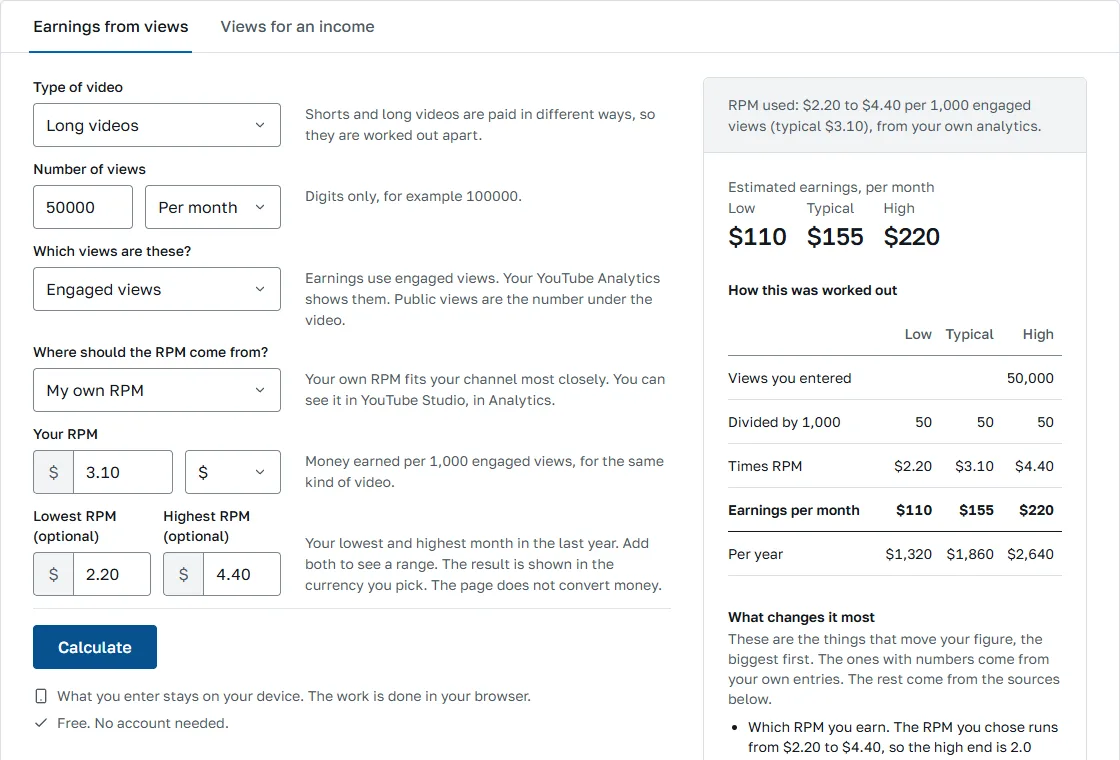
If your analytics show an RPM, put that in a calculator, ideally with your lowest and highest recent month so you see a range. The YouTube money calculator takes your own RPM, shows the three figures and each step of the sum, and does not ask for anything else.
Without an RPM of your own, how much YouTube pays per 1,000 views lists published figures by topic and country. And if your RPM looks fine but your income does not, the post on views and engaged views covers the other half of the sum.
Sources
All pages were read on November 29, 2026.
- YouTube Help, Understand ad revenue analytics
- AIR Media-Tech, which YouTube niche makes the most money in 2026, July 1, 2026
This site is not connected with YouTube, Google, AIR Media-Tech or Social Blade. The post is for information and is not financial advice.